
If you regularly wake up tired after 8 hours, you are not imagining it, and it does not automatically mean you “need more sleep.” Most healthy adults are generally advised to aim for at least 7 hours, often within a 7 to 9 hour range, but those same recommendations also emphasize that next day functioning and sleep quality matter, not just time in bed. If you want the clinical context, the Sleep journal consensus statement is a helpful starting point: Recommended sleep duration for healthy adults. For public health framing, you can also review AASM guidance on adult sleep duration and CDC sleep facts for adults. In practical terms, waking up tired after “enough hours” usually points to one thing: your sleep time did not convert into full recovery because continuity, timing, or physiology was disrupted. If you want a broader foundation and a simple framework for improving stability night after night, start here: Sleep.
Why 8 hours can still feel unrefreshing
The most common reason is sleep fragmentation: brief micro arousals that you often do not remember, but your brain and body still pay the cost. Noise, light leakage, room temperature swings, stress, and a partner’s movement or snoring can repeatedly nudge the brain toward lighter sleep, which reduces deep sleep continuity and leaves you feeling “awake but not restored” in the morning. A clear public health style explanation of how frequent arousals reduce the restorative value of sleep is summarized in CDC NIOSH guidance on sleep quality and frequent awakenings. If your bedroom setup is already working against you, improving the environment often makes any strategy more effective, because it removes the triggers that keep interrupting sleep. Here is a practical guide to start with: The importance of a healthy sleep environment.
Sleep inertia: when you wake up at the wrong point in the cycle
You can wake up tired even after a full night if your alarm pulls you out of deeper sleep, causing sleep inertia, a well described transition state marked by grogginess, slower thinking, and reduced alertness that can last from minutes to over an hour depending on sleep stage and circadian timing. This is not a willpower problem, it is a biological effect that has been studied as a real impairment window after waking, and two research level overviews are especially useful if you want the evidence: Sleep inertia explained in clinical research and How sleep inertia affects performance after waking. Practically, if you feel foggy for 30 to 90 minutes most mornings, it can be worth testing a slightly earlier wake time for several days while keeping it consistent, because consistency increases the chance you wake in a lighter stage and reduces the “hit or miss” feeling that makes mornings unpredictable.
Circadian timing: when your body clock and your schedule disagree
Circadian rhythm is the internal timing system that shapes when your body wants to sleep and when it wants to be alert, and even with enough hours, sleep can feel unrefreshing if your schedule constantly shifts. This often happens when weekdays and weekends look very different, when you sleep in to “catch up,” or when late night screens and bright light keep your brain in a daytime state longer than you realize. Circadian rhythm disruptions are recognized clinically, and a clear medical overview is available here: Cleveland Clinic overview of circadian rhythm disorders. The simplest stabilizer is usually a consistent wake time plus morning light exposure, because your circadian system responds strongly to predictable morning signals, and once that anchor is set, sleep pressure often builds more naturally at night.
What actually helps vs what only masks the problem

The interventions with the best practical payoff usually improve stability, not just comfort. A steady wake time reduces circadian drift, morning light helps reinforce daytime alertness, and a cooler, darker, more predictable bedroom reduces sensory triggers that cause micro arousals, especially in light sleepers. If evenings are part of your pattern, nutrition timing can quietly interfere with sleep quality for some people, so this guide can help you identify common triggers: Foods to avoid before bedtime. If your body feels “wired” at night, a short wind down that helps downshift is often more effective than forcing an early bedtime, and gentle stretching can be one option: The best bedtime stretches for better sleep. What often masks the problem instead of solving it includes repeated snoozing, weekend sleep marathons, and relying on caffeine as the main tool, because these strategies may improve how you feel briefly without fixing the underlying fragmentation or timing issue.
A simple three night plan to test what is driving your morning fatigue
If you want a plan that is structured but realistic, run a three night test that isolates the most common drivers of waking tired while keeping everything else steady. Night 1 to Night 3, set a fixed wake time and keep it consistent even if the previous night was imperfect, because consistency is part of the intervention; protect the first two hours of sleep by reducing noise and other disruptions since early night stability often improves the whole night’s architecture; and keep your wind down short and repeatable, such as ten minutes of low stimulation time and a clear stop point for screens. Each morning, record three quick markers in one line: how long it took to feel mentally “online,” whether you remember awakenings, and whether your energy is stable by late morning. If fatigue remains intense or persistent, or you notice loud snoring with choking or gasping, morning headaches, or strong daytime sleepiness, it may be worth reviewing broader sleep conditions and next steps here: Common sleep disorders and next steps.
When you wake up tired after 8 hours, what usually matters most
For many people, the pattern comes down to which lever is actually limiting recovery in their real environment. If your main issue is inconsistent timing, consistency usually wins first. If your main issue is micro arousals from noise and movement, continuity usually wins first. If you feel heavy grogginess despite stable nights, sleep inertia and wake timing may be the key. The goal is not to chase perfect sleep, but to reduce the biggest source of disruption so recovery can happen more reliably.
Where SomniPods 3 and AI Coach fit into the picture
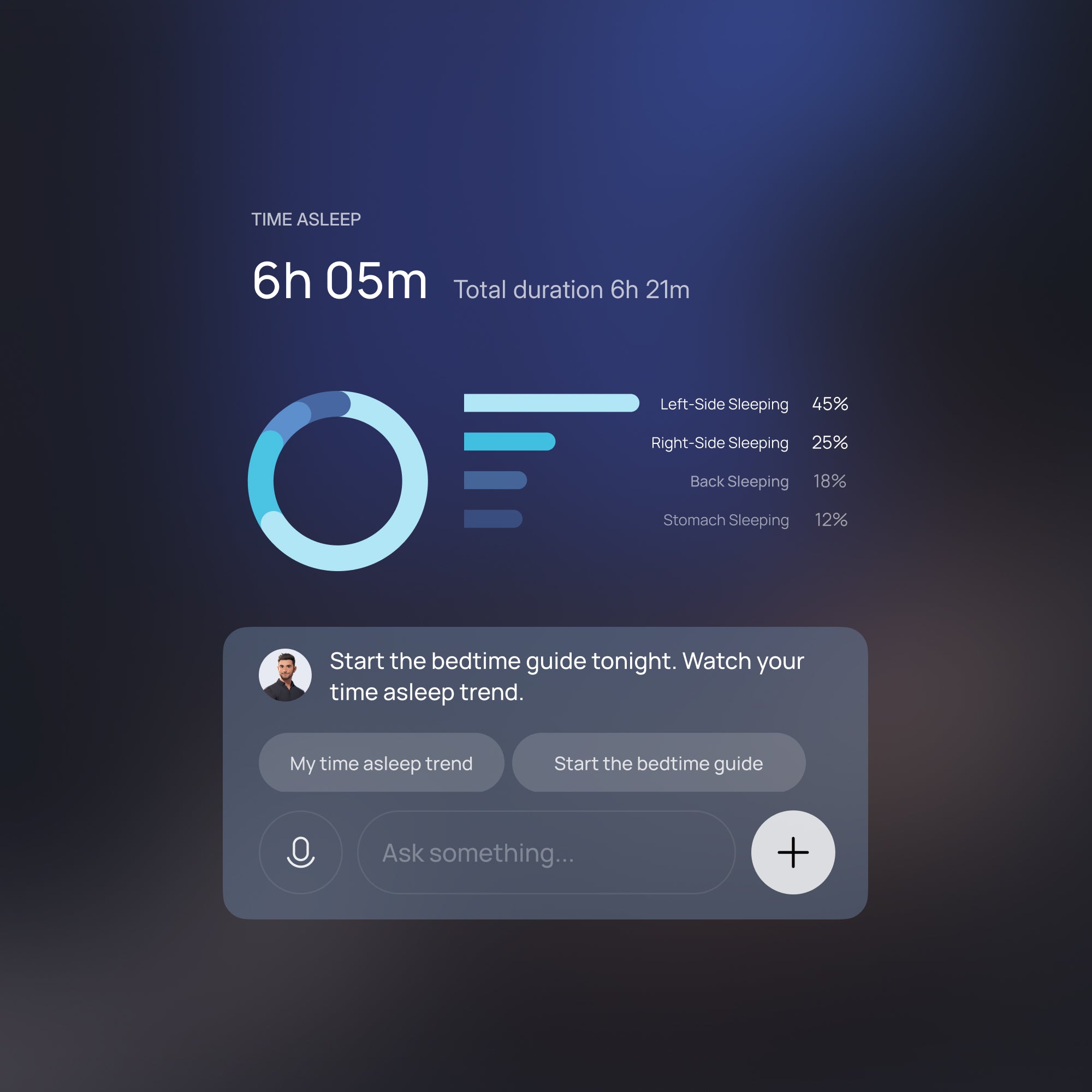
If your “8 hours but tired” pattern is driven by light sleep, micro awakenings, or a noisy environment, the limiting factor is often not motivation but control. Bedside speakers and sound machines can help some people, but they also create a tradeoff: the volume needed to smooth disruptions may disturb a partner, while lower volume may not stabilize sound once you change position overnight. Fitnexa SomniPods 3 are designed for overnight comfort and side sleep friendliness, keeping a stable sound layer close to the ear so you can support continuity without raising ambient volume for the entire room. Paired with the Fitnexa App, AI Coach helps connect your sleep patterns to structured Tonight Plan suggestions, so you reduce trial and error and focus on the variables that actually change how you feel in the morning. If you want a balanced perspective on sleep tracking and whether data helps or overwhelms, this article can add context: Do sleep tracker apps actually help.
Final thoughts
Waking up tired after 8 hours is usually a signal that sleep quality, timing, or continuity is being disrupted, not proof that you are “bad at sleep.” The most reliable improvements come from reducing fragmentation, stabilizing circadian timing with consistent mornings, and creating an environment that lets the brain stop monitoring for change. If noise sensitivity and light sleep are central to your pattern, SomniPods 3 can help you protect your sleep window in a partner friendly way, and AI Coach can help you move from generic advice to a Tonight Plan that fits how you actually sleep.
Explore SomniPods 3 here: Shop SomniPods 3
If you want guidance that adapts to your sleep patterns instead of generic tips, you can also start here: Fitnexa App and AI Coach